

Payroll is one of the most time-consuming, compliance-heavy tasks a business manages and one of the costliest to get wrong. A single miscalculation can mean unhappy employees, IRS penalties, and hours of corrective work. Yet many businesses still handle it in-house long after it makes financial sense to do so.
Outsourcing payroll has become the go-to solution for growing businesses that want to reduce administrative burden, stay compliant, and free their teams to focus on work that actually drives growth. This blog post covers the core benefits of outsourcing payroll, what functions are typically handed over, the honest trade-offs to consider, and how to choose the right partner.
Why Businesses Outsource Payroll Services
The decision to outsource payroll usually comes down to one or more of the same recurring pain points.
Time and Resource Cost
Processing payroll in-house means tracking employee hours, managing deductions, calculating taxes, filing returns, and staying current on federal, state, and local regulatory changes – all before a single check goes out.
For small and mid-sized businesses without a dedicated payroll specialist, this often falls on a founder, office manager, or accountant juggling other responsibilities. The time cost alone makes outsourcing worth exploring.
Compliance Risk
Payroll regulations are complex and change regularly. The IRS collected over $6 billion in employer penalties last year due to payroll mistakes, a figure that reflects how easy it is for in-house teams without specialist knowledge to fall behind.
Outsourcing payroll and benefits to a dedicated provider means compliance is managed by people whose job it is to stay current on every regulatory change.
Cost Efficiency
Many business owners assume outsourcing is more expensive than handling payroll in-house. In practice, the opposite is often true.
When you factor in staff time, payroll software subscriptions, training costs, and the financial exposure from errors or penalties, outsourcing frequently comes in at a lower total cost, especially for businesses under 100 employees.
How Payroll Outsourcing Improves Accuracy, Compliance, and Reporting
The operational benefits of outsourcing payroll advantages extend well beyond saving time.
Fewer Errors, Fewer Penalties
Manual payroll processing carries a high risk of human error – miskeyed hours, missed deductions, and incorrect tax withholdings. Specialized payroll providers use automated systems that reduce this risk significantly, with dedicated review processes that catch mistakes before they become payroll runs. In the US, 1 in 4 employees has experienced a payroll error, a statistic that erodes employee trust fast.
Staying Ahead of Tax Law Changes
Federal, state, and local payroll tax rules change constantly. Multi-state employers face an even more complex compliance landscape.
Payroll outsourcing providers track legislative changes across all jurisdictions your business operates in, applying updates before they create compliance gaps.
Better Reporting and Visibility
Outsourced payroll providers typically offer detailed, customizable reporting – payroll summaries, tax liability reports, benefits deductions, paid time off tracking, and more. For business owners and finance teams, this means cleaner data flowing into accounting systems and better visibility for financial planning.
Technology Without the Overhead
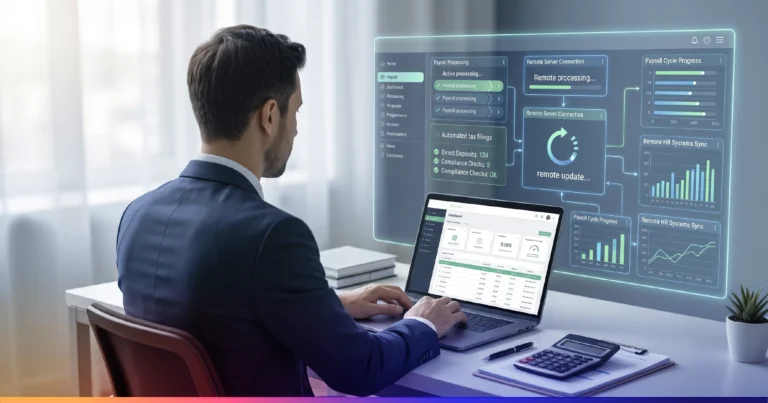
Reputable payroll providers invest in enterprise-grade software that most small businesses wouldn’t purchase independently. Automation, direct deposit, self-service employee portals, and integrations with accounting platforms like QuickBooks and Xero are standard features – with no additional software cost to your business.
Payroll Functions Businesses Commonly Outsource
Not every business outsources the same scope of payroll functions. The most common include:
Payroll processing – calculating wages, salaries, overtime, and deductions for each pay period and distributing payments via direct deposit.
Payroll tax filing – calculating, withholding, and filing federal, state, and local payroll taxes, including quarterly and annual filings like Form 941 and W-2s.
Benefits administration – managing employee benefit deductions such as health insurance premiums, retirement contributions, and flexible spending accounts, often integrated directly into payroll runs.
Time and attendance tracking – many payroll providers include time tracking tools that feed directly into payroll calculations, eliminating manual data transfer.
Year-end reporting – W-2 and 1099 preparation, distribution to employees, and IRS filing by the required deadlines.
Businesses that also need bookkeeping, accounting, and tax support alongside payroll often find it more efficient to consolidate these functions with a single outsourced finance partner rather than managing separate vendors. Befree’s payroll outsourcing services handle the full scope – from processing to compliance – as part of an integrated accounting and bookkeeping solution.
How to Choose the Right Payroll Outsourcing Partner
Not all payroll providers offer the same level of service. A few factors matter most when evaluating options.
Experience With Your Business Size and Structure
A payroll provider experienced with businesses at your size and stage will understand your compliance requirements and reporting needs. Ask specifically about experience with your entity type – S corp, LLC, multi-state – and whether they’ve handled businesses in your industry.
Integration With Your Accounting Software
Payroll data needs to flow cleanly into your accounting system. Confirm the provider integrates with your existing platform or is willing to migrate you to a compatible one to avoid double-entry and reconciliation issues downstream.
Transparent, Predictable Pricing
Ask for a clear breakdown of all fees before signing anything. Some providers charge separately for year-end forms, tax filing corrections, onboarding new employees, or off-cycle runs. Understanding the full cost structure upfront prevents billing surprises.
Data Security Practices
Payroll data is among the most sensitive your business holds – Social Security numbers, bank account details, compensation records. Confirm the provider uses encrypted systems, strict access controls, and has a clear data breach response policy.
Responsiveness When Errors Happen
Payroll errors are rare with a good provider, but they do happen. Ask specifically how long corrections take and how issues are communicated. A provider that’s difficult to reach when something goes wrong is a significant operational risk. See how Befree’s accounting outsourcing services integrate payroll with your broader financial operations for a more seamless experience.
Ready to Take Payroll Off Your Plate?
The benefits of outsourcing payroll are clear: less time spent on administration, lower risk of costly errors, stronger compliance, and better financial reporting. But the real value comes from choosing a partner who understands your business – not just a software platform that processes payments.
Befree’s team integrates payroll outsourcing with bookkeeping services, accounting, and tax support, so your financial operations run as one connected system instead of separate moving parts.
Stop spending your best hours on payroll admin. Get in touch with Befree’s team to see what outsourcing looks like for your business.
FAQs
What are the main benefits of outsourcing payroll?
Time savings, reduced errors, better compliance, and lower overall cost compared to managing payroll in-house, especially for small and mid-sized businesses.
What are the disadvantages of outsourcing payroll?
Less direct control over the process, potential data security concerns, and dependency on a third party if errors occur. Choosing a reputable provider with strong security and responsive support minimizes these risks.
Is outsourcing payroll cost-effective for small businesses?
Yes, in most cases. When you factor in staff time, software, training, and the cost of errors or penalties, outsourcing is typically cheaper than managing payroll internally.
What payroll functions can be outsourced?
Most payroll functions can be outsourced, including payroll processing, tax filing, benefits administration, time tracking, and year-end W-2 and 1099 preparation.
Can I outsource payroll and benefits together?
Yes. Many payroll providers offer integrated benefits administration – handling deductions for health insurance, retirement plans, and other benefits as part of the same payroll run.
How do I switch from in-house payroll to an outsourced provider?
The transition typically involves a provider onboarding your employee data, tax history, and current payroll setup. A good provider manages this process with minimal disruption, ideally starting at the beginning of a new quarter or calendar year.