




If you’ve been running an accounting firm for a few years, you’ve probably noticed something strange: the busier you get, the harder it becomes to keep things running smoothly. More clients, more work, more people – and somehow, more chaos.
It’s not because your team isn’t capable. It’s usually because the processes that worked when you had 20 clients weren’t designed to handle 80. And nobody stopped to fix them because everyone was too busy doing the work.
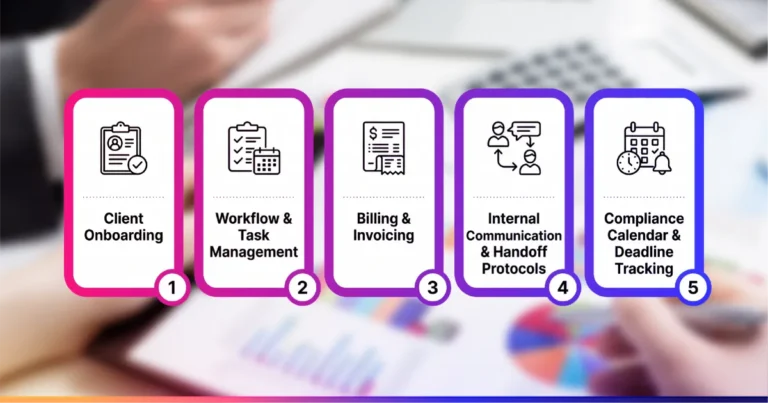
Sound familiar? Here are five administrative processes worth getting right before they become a problem.
How do Inconsistent Administrative Processes Restrict Firm Growth?
Let’s be honest – most accounting firms run on a mix of informal systems, tribal knowledge, and good intentions. And for a while, that works fine.
But when you start growing, those cracks get harder to ignore. A client complains their onboarding felt disorganized. An invoice gets missed for three months because nobody was tracking it. A filing deadline almost slips through because it lived in a partner’s head rather than a shared calendar.
None of these feels like a catastrophe on their own. But they add up – in client trust, in cash flow, and in the number of hours your senior people spend firefighting instead of doing actual work.
The good news?
Most of these problems have the same root cause: the firm never took the time to standardize how things get done. That’s where accounting process improvement starts – not with expensive software, but with deciding how things get done and sticking to it. Fix that, and a lot of the chaos sorts itself out – and increasing accounting efficiency becomes a byproduct of simply running things consistently.
5 Administrative Processes Growing Accounting Firms Should Standardize
1. Client Onboarding
Think about the last time you onboarded a new client. Was the process the same as the time before? Did your team follow the same steps, collect the same documents, and send the same kickoff communication, or did it depend on who was leading the engagement?
For most firms, the honest answer is: it depends. And that’s a problem, because inconsistent onboarding creates inconsistent first impressions. Clients notice when things feel disorganized, even if they can’t put their finger on exactly what went wrong.
A simple onboarding checklist – document collection, engagement letter, software access, kickoff call – goes a long way. It doesn’t need to be complicated. It just needs to be the same every time.
2. Workflow and Task Management
Here’s a quick test: right now, without asking anyone, can you tell where every active engagement in your firm sits? Who’s working on it, what stage it’s at, and when it’s due?
If the answer involves checking multiple email threads or asking around, that’s worth fixing. When work moves through your firm based on memory and informal communication rather than a defined system, things fall through the gaps, especially when someone’s out sick or the firm gets busy.
A clear workflow doesn’t have to mean expensive software. It means every job has defined stages, a clear owner at each stage, and a way for anyone on the team to check the status without having to chase someone down. That alone does a lot for increasing accounting efficiency across the board – and it’s the foundation of real accounting process improvement that scales with the firm.
3. Billing and Invoicing
This one’s straightforward, but it’s where firms consistently leave money on the table.
When billing is handled ad hoc – when someone gets around to it, when they remember – invoices go out late, follow-ups don’t happen on schedule, and AR ages quietly in the background while everyone’s focused on delivering work. It’s only when you reconcile at month-end that you realize how much is sitting unpaid.
Standardizing billing doesn’t need to be complicated. Decide when invoices go out, who sends them, what the follow-up looks like at 30, 60, and 90 days, and stick to it. If you’re moving toward recurring billing models, this infrastructure is even more important because predictable cash flow depends on predictable collection.
4. Internal Communication and Handoff Protocols
Every time a piece of work moves from one person to another – from preparer to reviewer, from your team to an outsourced partner – information either travels with it or it doesn’t. When it doesn’t, the next person has to reconstruct context from scratch. Review cycles stretch. Turnaround times slip.
The fix is simple: define what needs to be documented before work changes hands. What’s been done, what’s outstanding, where the files are, what the client has been told. It takes five minutes to write up and saves thirty minutes of confusion on the other end.
This matters even more if you’re working with an outsourced team. A well-documented handoff is what makes external support actually work; otherwise, you spend more time coordinating than you save.
5. Compliance Calendar and Deadline Tracking
No firm misses a deadline on purpose. It happens because deadlines were tracked in the wrong place – a spreadsheet someone forgot to update, a calendar only one partner could see, or worse, memory.
A shared compliance calendar, with every client’s filing deadlines, extension dates, and estimated tax due dates visible to the whole team, is one of the simplest finance process improvements you can make. Set it up once, maintain it as clients come and go, and you’ve removed one of the most avoidable risks in the firm.
How can Accounting Outsourcing Support Consistent Process Execution?
Accounting process improvement doesn’t stop at internal workflows. Here’s something worth knowing before you go down the outsourcing route: it works best when your processes are already defined.
If your workflows are unclear internally, handing work to an external team won’t fix that – it’ll just move the confusion outside the building. But when your processes are solid, outsourcing becomes a genuine lever for growth. An external team handles the transactional layer consistently and at scale, while your internal team focuses on review, advisory, and client relationships.
That’s the model that lets firms take on more clients without a proportional increase in headcount.
Befree’s bookkeeping outsourcing services plug directly into the workflows US accounting firms already have in place – handling the transactional layer so your internal team stays focused on review, advisory, and client relationships. That’s the model that lets firms take on more clients without a proportional increase in headcount.
Small Fixes, Big Difference
None of these five processes requires a major overhaul. They’re not expensive to implement, and they don’t need a consultant to set up. What they need is a decision to prioritize them – ideally before the firm gets busy enough that fixing them feels impossible.
The firms that scale without the chaos are usually the ones that got these basics right early. It’s worth the investment.
Contact our team today to find out how Befree helps US accounting firms build efficient, scalable operations.