




Most employees know their take-home pay is less than their gross pay. Fewer understand exactly why or how the deductions taken before taxes are calculated are doing more work than the ones taken after.
That distinction matters. Getting pre-tax deduction coding wrong in payroll doesn’t just affect one paycheck. It compounds across every pay run, creates W-2 discrepancies, and puts the employer at risk of IRS penalties. The IRS assessed $84.1 billion in civil penalties in fiscal year 2024, with the majority tied to employment tax violations – most of which trace back to payroll setup errors.
Here’s how pre-tax deductions actually work, with 2026 figures throughout.
Which Payroll Deductions Come Out Before Taxes?
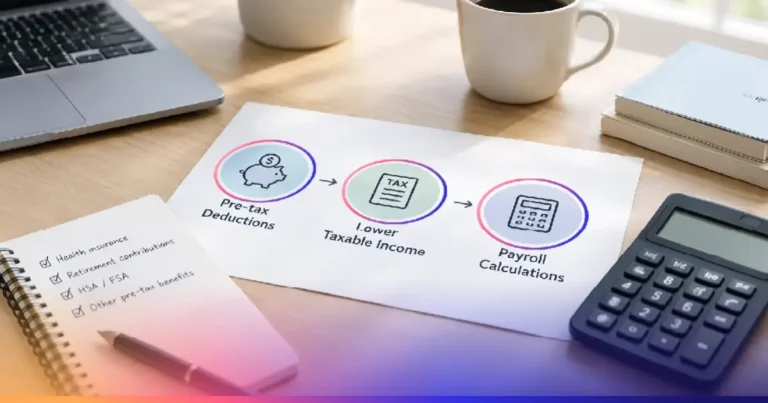
Pre-tax deduction meaning, simply put: an amount subtracted from an employee’s gross wages before federal income tax and, in some cases, FICA taxes are calculated. The result is a lower taxable income and a smaller tax bill for the employee.
The most common examples of pre-tax deductions in 2026:
401(k) traditional contributions – reduce federal income tax but not FICA. The 2026 elective deferral limit is $23,500, with a catch-up limit of $31,000 for employees aged 60–63 under the SECURE 2.0 Act.
Health insurance premiums under a Section 125 plan – reduce both federal income tax and FICA (Social Security and Medicare). This is one of the most tax-efficient benefits available because it reduces wages subject to both taxes simultaneously.
Health FSA contributions – the 2026 limit is $3,400 per employee. Pre-tax for both income tax and FICA when run through a Section 125 plan.
HSA contributions – the 2026 limit is $4,400 for self-only coverage and $8,750 for family coverage. Pre-tax for income tax and FICA.
Dependent care FSA – up to $5,000 per household pre-tax in 2026. Exempt from income tax and FICA under Section 129 rules.
Commuter benefits – transit and parking benefits are pre-tax up to $340 per month each in 2026.
What are pre-tax deductions that don’t qualify? Roth 401(k) contributions, life insurance above $50,000 in employer-paid coverage, and wage garnishments all run post-tax.
What Changes When Payroll Subtracts Pre-tax Deductions From Gross Pay?
The payroll sequence determines everything:
Gross pay → subtract pre-tax deductions → taxable wages → calculate taxes → subtract post-tax deductions → net pay
Take a practical example of pre-tax deductions at work. An employee earns $5,000 gross per pay period. They contribute $500 to a traditional 401(k) and pay $300 in health insurance premiums under a Section 125 plan.
- Taxable wages for federal income tax: $5,000 − $500 − $300 = $4,200
- Taxable wages for FICA: $5,000 − $300 = $4,700 (401k doesn’t reduce FICA; health insurance does)
Federal income tax is calculated on $4,200. Social Security and Medicare are calculated on $4,700. The employee pays less tax than they would on the full $5,000 – and the employer’s matching FICA contribution is also lower on the health insurance portion.
This is why correct payroll coding matters. Mis-coding a Section 125 deduction as post-tax means the employee overpays FICA every pay period – and the employer does too.
Why Do Pre-Tax Deductions Affect Taxes And Take-Home Pay Differently?
Not all pre-tax deductions reduce the same taxes, and payroll errors most commonly occur here.
Federal income tax: All standard pre-tax deductions reduce it – 401(k), health insurance, FSA, HSA, commuter benefits.
FICA (Social Security and Medicare): Only Section 125 plan elections reduce it. Traditional 401(k) contributions do not reduce FICA, even though they’re pre-tax for income tax purposes. This distinction trips up payroll setup more than almost anything else.
State income tax: Most states follow federal treatment, but not all. Pennsylvania, for example, doesn’t exempt health insurance premiums from state income tax even when they’re pre-tax federally. Multi-state employers need to verify each state’s treatment separately.
The take-home pay effect is straightforward: the more pre-tax deductions an employee has, the lower their taxable wages and the more they keep per paycheck – even before considering the benefit itself. An employee contributing the maximum to a health FSA ($3,400 in 2026) saves roughly $260 in FICA taxes alone, in addition to income tax savings.
Which Payroll Checks Prevent Deduction And Tax Errors?
A structured payroll review process catches most pre-tax deduction errors before they create downstream problems. The checks worth running each pay period:
Deduction type verification. Confirm each benefit deduction is coded as pre-tax or post-tax correctly in the payroll system. Section 125 elections must reduce both income tax and FICA wages; 401(k) contributions reduce only income tax wages.
Annual limit tracking. Each pre-tax deduction has an IRS cap. Contributions above the limit switch to post-tax treatment – the payroll system should flag and stop pre-tax deductions when limits are reached, not continue applying them incorrectly.
W-2 reconciliation. Pre-tax deductions appear in specific W-2 boxes. Box 1 (federal wages) should reflect the reduction from all pre-tax deductions. Boxes 3 and 5 (Social Security and Medicare wages) should only reflect FICA-exempt Section 125 reductions. A discrepancy between these boxes and payroll records is a filing error.
Mid-year election changes. Employees who change benefits mid-year trigger deduction updates that need to be applied accurately and prospectively — not retroactively adjusted in a way that creates cumulative errors.
Befree’s payroll outsourcing services handle pre-tax deduction setup, limit tracking, and W-2 reconciliation for US businesses – reducing the risk of the kind of payroll errors that attract IRS attention.
Payroll Gets Complicated Quickly – Especially at Scale
Pre-tax deductions are one of the more nuanced parts of payroll. The rules aren’t complicated once they’re understood, but they interact in ways that are easy to misconfigure – particularly for employers with multiple benefit elections, multi-state workforces, or high employee turnover driving frequent mid-year changes.
Getting this right isn’t just about employee satisfaction. It’s about staying on the right side of the IRS.
Contact our team today to find out how Befree helps US businesses manage payroll deductions accurately and compliantly.