


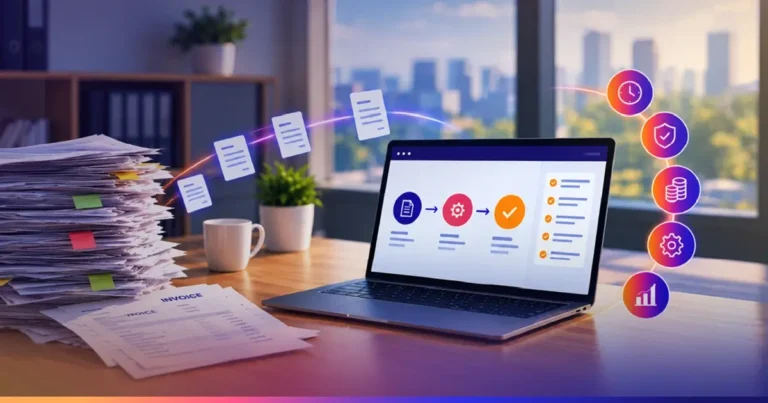
Your business should automate accounts payable when manual invoice handling starts to cause late payments, coding errors or slow month-end reporting. Automation captures supplier invoices, matches them to purchase orders, routes them for approval and schedules payment, with far less keying and chasing. For UK business owners, finance managers and directors, the right moment usually arrives before the problems become costly.
This guide sets out the clearest warning signs, the features worth prioritising and the results to measure afterwards.
What Does a Finance Director Do?
7 Signs Your Business Should Automate Accounts Payable
1. Invoices are still keyed in by hand
2. Approvals stall in inboxes
3. Late payments and missed discounts are common
4. Duplicate or fraudulent invoices slip through
5. VAT and CIS records take too long to reconcile
Businesses in construction and property need accurate CIS deductions and the correct VAT treatment on every invoice. If reconciling these takes days, specialist bookkeeping services alongside automation can restore control and reduce the risk of HMRC queries.
6. Month end is a scramble
7. Volume is growing faster than headcount
A rising number of suppliers, sites or entities makes manual processing unsustainable. Under Making Tax Digital (MTD), digital records are increasingly the expectation, so a structured process also supports compliance.
Which accounts payable software features matter most?
Not every platform suits every business. When comparing accounts payable software, prioritise:
- Optical character recognition (OCR) and data capture: extracts invoice details accurately, including VAT and CIS fields.
- Three-way matching: compares invoices, purchase orders and delivery records.
- Configurable approval workflows: routes invoices by value, supplier or department.
- Integration with your accounting system: syncs with Xero, QuickBooks, Sage and similar platforms.
- Audit trails and access controls: supports internal controls and audit readiness.
- Payment scheduling: aligns payment runs with terms and cash flow forecasts.
Industry guides on AP automation note that integration and control features tend to deliver the most lasting value. Many businesses pair payables automation with professional accounting services so that exceptions are reviewed by qualified people, not left in a queue.
Which results should you measure after automation?
Set a baseline before go-live, then track:
- Cost per invoice processed: total handling cost divided by invoice volume.
- Invoice cycle time: days from receipt to approval and payment.
- Exception rate: the share of invoices needing manual correction.
- On-time payment rate: invoices paid within agreed terms.
- Early payment discounts captured: a direct measure of margin recovered.
- Month-end close time: days taken to finalise the payables ledger.
Conclusion
The case to automate accounts payable is strongest when errors, delays and rising volumes begin to outpace your team. If several of the signs above sound familiar, a review of your current process is a sensible next step. The right payables automation protects accuracy, supplier relationships and compliance, and a practical guide to AP automation can help you build the business case internally.
This is where Befree can help. Our automation services combine intelligent automation, Robotic Process Automation (RPA) and AI-driven technology with skilled finance professionals. Routine tasks such as bill processing, transaction coding, payment reconciliation and ledger maintenance run on autopilot, while our experts remain in the loop for quality control and compliance. Workflows are tailored to your existing processes and connect with platforms including Xero, QuickBooks, Sage and NetSuite. Security is built in too, with governance aligned to ISO 27001:2022 and ISO/IEC 27701:2019, GDPR-aligned practices and encrypted, access-controlled environments.
Ready to streamline your payables?
Befree helps businesses build efficient, compliant finance processes. Contact our team to discuss how we can support you.