




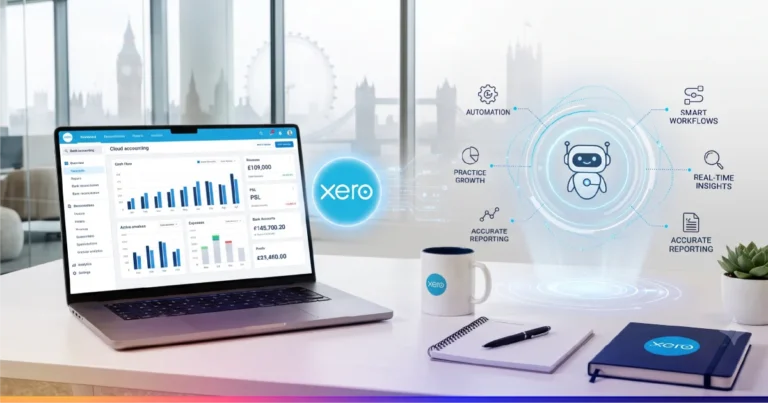
Xero bookkeeping is entering a new phase, one shaped by AI agents that can reconcile transactions, chase documents, and draft month-end journals with minimal human input. For UK bookkeepers, this shift does not remove the need for professional judgement. It changes where that judgement is applied, moving practices away from data entry and towards review, exceptions, and advisory work.
This article sets out what is actually changing inside Xero cloud accounting, what it means for day-to-day bookkeeping work, and how UK practices can prepare without losing the compliance rigour that HMRC, MTD, and CIS obligations demand.
What Does "Agentic" Mean for Xero Bookkeeping?
“Agentic” describes software that can take multi-step action on your behalf, not just surface information. Rather than flagging an unreconciled transaction and waiting for a human to act, an agentic system can investigate the transaction, match it against likely candidates, and complete the reconciliation itself, subject to review.
Xero’s agentic platform, JAX, sits at the centre of this shift. According to Xero’s own announcements, JAX is designed to give customers a trusted system of action with real-time visibility and forward-looking insight, without asking them to give up control or compromise on accuracy. For bookkeepers, the practical effect is that routine, rules-based tasks increasingly happen automatically, while people are pulled in for exceptions, judgement calls, and client conversations.
Which Xero Cloud Accounting Features Are Changing First?
A handful of capabilities are worth tracking closely, because they touch the core of everyday bookkeeping work.
- Automated bank reconciliation: Xero has stated that its Auto Bank Reconciliation feature is already saving accountants and bookkeepers around 50% of their monthly bank reconciliation time, matching high-confidence transactions automatically while surfacing any exceptions that require human expertise. The direction of travel is clear: reconciliation is becoming a review task rather than a manual one.
- Document capture and chasing: New Document Requests functionality allows the platform to request missing documents from clients, send reminders, and match responses to transactions, with the system making sure customers get to approve every step. This addresses one of the most persistent bottlenecks in bookkeeping: waiting on client paperwork.
- Custom agent building: XeroForce, Xero’s natural language agent builder, now includes a pre-built month-end agent capable of reviewing document reconciliation status, right through to manual journal entries for prepayments and amortisation, before presenting a complete summary for the practice to review and accept.
- Working outside Xero itself: Xero has also launched an integration with Microsoft 365, bringing live financial data in Xero to small businesses and accountants wherever they choose to work. In practice, this means figures from Xero cloud accounting can appear directly inside Excel, Word, and PowerPoint, grounded in the client’s actual ledger rather than a static export.
How Should UK Bookkeeping Firms Prepare?
Preparation is less about adopting every new feature immediately and more about deciding deliberately how your practice will work alongside these tools.
- Review your reconciliation workflow: If automated matching is already handling the majority of routine transactions, staff time should be reallocated towards checking exceptions, understanding why anomalies occurred, and communicating findings to clients, rather than manual line-by-line entry.
- Reassess where your value sits: As transactional tasks compress, the differentiators for UK bookkeeping firms become regulatory fluency (MTD for Income Tax, VAT scheme selection, CIS status determinations, PAYE and NIC treatment) and the ability to interpret what the numbers mean for a client’s business.
- Keep client approval visible: Every agentic feature Xero has released so far has been framed around human oversight, not replacement. Firms should build this into their own processes too: agreed thresholds for automatic action, clear audit trails, and a documented point at which a human reviews and signs off.
- Train staff on exception handling, not just software use: The bookkeepers who benefit most from this shift will be the ones confident in spotting what an automated system might miss, particularly around VAT liability, CIS deductions, or unusual client transactions that don’t fit a standard pattern.
- Watch the app ecosystem: Xero has reported a 4x increase in new app registrations since 2025, with a growing share of connections into Xero built as custom apps. UK practices should expect the range of add-ons and integrations touching client data to widen, and should have a process for vetting what connects to client files.
Does This Change Bookkeepers' Compliance Responsibilities?
No. Automation inside Xero cloud accounting does not change who is accountable to HMRC. Self Assessment filings, VAT returns, CIS submissions, and payroll reporting still require a named, responsible professional. What changes is the proportion of time spent on preparation versus review. Firms offering Xero bookkeeping services should use the time these tools free up to strengthen client review and advisory work, not to reduce the overall time spent on compliance oversight.
Getting the Balance Right
The practices that adapt well will not be the ones that resist automation, nor the ones that hand over full control without a documented review process. They will be the ones that use agentic capability to strengthen accuracy and free up time for judgement-based work, while keeping HMRC compliance and client trust firmly in human hands.
At Befree, we work with UK bookkeeping firms to build Xero-based processes that combine efficient automation with the regulatory discipline your clients expect. If your practice is reviewing how Xero bookkeeping fits into its workflow, get in touch with the Befree team to talk through what preparation looks like for your firm.
FAQs
What is Xero bookkeeping?
Xero bookkeeping is the use of Xero’s cloud accounting software to record, reconcile, and report a business’s financial transactions, including bank reconciliation, VAT preparation, payroll data, and Making Tax Digital submissions to HMRC.