


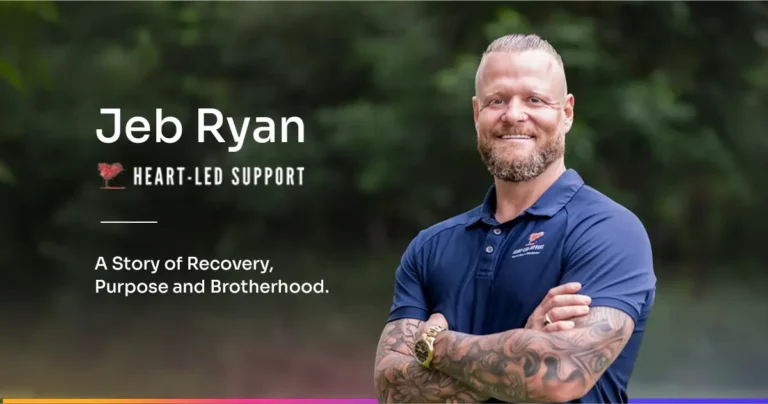
After years of losing himself to addiction and struggling to find his way through it all, Jeb Ryan has spent the better part of a decade helping other men find their footing. Through Heart Led Support, he is building something he knows from experience can change a life: a place to belong.
This is a different kind of loneliness – one that compels you to believe that you have to figure it out on your own.
For many men, asking for help does not come naturally. Sometimes, they don’t really understand what is going on, sometimes they are just struggling to meet societal expectations of them “being strong”, and most of the time, it is the years of social conditioning. Early on, men are taught to treat vulnerability as something best kept hidden. And that is exactly what makes their lives more difficult than they really are.
Jeb Ryan understands what that kind of isolation can do to a person. Not from a distance, and not simply through the work he does today, but from having experienced his own difficult years.
His childhood lacked the guidance and stability any child of his age needed. As he grew older, he struggled to find direction, eventually developing a drug problem. The path out was neither immediate nor straightforward. What made the difference was finding people who were willing to show up for him, offer support, and help him see and realise that this doesn’t have to be his entire life and can be something that can be left behind.
Jeb has now been sober for seven years.
But the significance of that milestone extends beyond his own recovery. The support he received became something he wanted to offer other people, particularly men who were navigating challenges of their own and had few places where they felt understood.
Today, he is the Chief Executive Officer of Heart Led Support, a male-to-male NDIS support provider built around a simple but meaningful premise: some people need more than care. They need connection, mentorship, and the opportunity to rebuild their confidence and sense of purpose.
For Jeb, that mission is personal.
Knowing what it feels like to need help
Before Heart Led Support existed, Jeb was just a young man trying to work out where he belonged.
Growing up without much parental guidance left Jeb feeling lost. His struggles with drugs followed, and the experience brought him face to face with the kind of difficulties that can become harder to navigate when someone feels they have no one to turn to.
Recovery changed the direction of his life, but it also changed the way he understood support.
It was not simply about getting through a difficult period. It was always about having people who believed things could be different for him, even when, sometimes, Jeb himself failed to see that possibility.
That experience stayed with him.
“I know what it feels like to be in a place where you’re struggling and you don’t necessarily know how to get out of it. What made a difference for me was having people who were willing to help, who gave me support when I needed it.”
Knowing that help is subconsciously available and having someone who understands why asking for it is probably difficult – that is where the difference lies.
That distinction would become central to Jeb’s work.
In 2017, he began mentoring people dealing with addiction, mental health challenges, and other difficulties that can make it harder to find stability in life and move forward. Over time, what began as a way of helping others became a sustained commitment.
He was not approaching these conversations as someone who had all the answers. He was drawing on his own experience to meet people where they were, without assuming that their circumstances could be understood from the outside.
For men who had experienced isolation, setbacks, or a loss of direction, that kind of connection could offer a starting point.
The loneliness men don't always talk about
The work Jeb does sits at the intersection of disability support, mental wellbeing, and human connection. But one of the challenges he is particularly conscious of is the difficulty many men face in talking openly about what they are going through.
Men are often conditioned to appear strong, self-reliant, and in control. Those expectations can make it harder to acknowledge when something is wrong, let alone ask another person for help.
The consequences can be significant. Someone may be struggling with their mental health, dealing with addiction, trying to rebuild their life after incarceration, or simply finding it difficult to connect with others. Yet the very act of admitting that they need support can feel like another obstacle.
For Jeb, this is where understanding matters.
His approach recognises that support is not always about having the right advice or offering an immediate solution. Sometimes, it begins with creating the conditions in which someone feels comfortable enough to talk.
That means building trust over time. It means recognising the person beyond their diagnosis, their past, or the difficulties they are experiencing. And it means understanding that progress looks different for everyone.
Jeb knows the value of that commitment because he has experienced it himself.
From personal experience to a purpose of his own
For several years, Jeb continued mentoring and supporting people, building on the work he had begun in 2017. Eventually, the idea of creating something more structured began to take shape.
The encouragement to take that next step came from the people around him, particularly Darren Kidd, who is now Chief of Operations at Heart Led Support.
Starting an organisation meant turning a personal commitment into something that could reach and support a much wider range of people. It meant building a team, establishing a way of working, and creating an organisation around values that mattered deeply to Jeb.
That journey led to Heart Led Support.
The organisation’s mission is to support men with disabilities to build confidence, freedom, purpose, and a stronger sense of self. Its approach brings together grounded mentorship, community access, physical wellbeing, and a sense of brotherhood.
The emphasis is telling. Heart Led Support is not positioning care as a checklist of tasks to be completed. It is built around the idea that people need opportunities to participate in life, develop independence, form meaningful relationships, and discover what matters to them.
Its values reflect that philosophy.
The service providers and the leader understand that a person may need assistance with everyday activities. But they may also need someone to encourage them to try something new, help them reconnect with their community, or give them the confidence to take a step they have been hesitant to make.
Those things may seem small from the outside. For the person experiencing them, they can be part of a much bigger change.
More than a service. A sense of belonging.
The phrase “male-to-male support” is central to Heart Led Support’s identity. It reflects an understanding that shared experience and relatability can help create trust, particularly for men who have found it difficult to open up.
It is not a suggestion that every man has the same experiences or needs the same kind of support. Rather, it recognises the value of relationships in which people feel comfortable being honest about their circumstances.
Heart Led Support’s focus on mentorship, movement, community participation, and physical wellbeing gives that philosophy a practical expression. Support is not confined to a conversation or a scheduled interaction. It can also involve helping someone become more active, develop new interests, reconnect with others, and find a greater sense of direction in everyday life.
The idea of brotherhood adds another dimension. It speaks to belonging without the expectation that someone must have everything figured out before they can be part of a community.
For men who have experienced addiction, mental health challenges, disability, or significant disruption in their lives, that sense of belonging can be particularly important. Their circumstances may be complex, and their progress may not follow a straight line. What matters is having support that recognises their individuality and gives them room to move forward at their own pace.
Jeb’s own story does not suggest that one person’s path to recovery can be replicated by another. It offers a more grounded lesson: the right support can make a difference, and people deserve the opportunity to find it.
The organisation he leads is an expression of that belief.
Alongside Jeb, the leadership team includes Darren Kidd, whose operational role helps bring the organisation’s work together, and Keagan Bizzell, Chief Human Resources Officer, an Army veteran and mentor whose work centres on helping men grow through movement and connection.
Together, they are building an organisation around a shared commitment to supporting men with disabilities in ways that extend beyond basic care.
The importance of a second chance
There is a tendency to define people by the most difficult chapters of their lives.
An addiction can become the defining detail of someone’s story. A period of incarceration can overshadow everything that came before or follows it. A mental health challenge can shape how others perceive a person, sometimes leaving little room for them to be seen as anything more than the difficulty they are experiencing.
Jeb’s work challenges this narrow view.
His own life has included difficult years, but those years are not the entirety of his story. His recovery, his decision to help others, and his work building Heart Led Support are equally important parts of it.
That perspective informs the way he approaches the people he supports. Their current circumstances do not have to determine their future, and their past does not have to be the only thing that defines them.
A second chance, however, is not simply a matter of telling someone they can change. It requires the conditions that make change possible: support, trust, encouragement, opportunity, and a community willing to see potential where a person may have difficulty seeing it themselves.
Jeb was fortunate enough to find people who offered him those things, and that is exactly the kind of support he has been trying to extend.
“I was given support when I needed it. I think about how much that mattered in my own life, and I want other men to know that they don’t have to go through everything alone. There is a way forward, and having the right people around you can make a real difference.”
A different kind of measure for success
When someone builds an organisation, success is often measured through growth, scale, and the number of people reached. Those measures have their place, particularly for a provider working to deliver consistent, meaningful support.
But the work Jeb describes also points towards a more personal measure.
It is in the confidence someone gradually develops. In the willingness to ask for help. In the friendships formed, the activities attempted, and the sense of purpose that begins to return. It is in the possibility that a person who once felt isolated can begin to see themselves as part of something again.
These changes may not always be easy to quantify, but they are central to the kind of support Heart Led Support aims to provide.
For Jeb, there is a clear line connecting the person he was, the people who helped him, and the work he does today. His experience does not make him an expert in every challenge another person might face. It gives him an appreciation for the importance of being met with understanding rather than judgement.
That appreciation has become the foundation of his work.
We met Jeb through the NDIS community in Australia, and what stood out was the personal conviction behind what he is building. His story is a reminder that meaningful work often begins with something deeply human: recognising a difficulty because you have experienced it yourself, and deciding to do something that might make the path easier for someone else.
Not everyone who receives support will go on to establish an organisation. Not every difficult experience will lead to a clear sense of purpose. There is no single, predictable path through recovery or towards a better life.
But Jeb’s journey offers a powerful reminder of what can happen when people are given the support, time, and opportunity to find their own way forward.
Thank you, Jeb, for taking the time to join us at the event and meeting our team. But more importantly, thank you for making the world a better place to live in.