


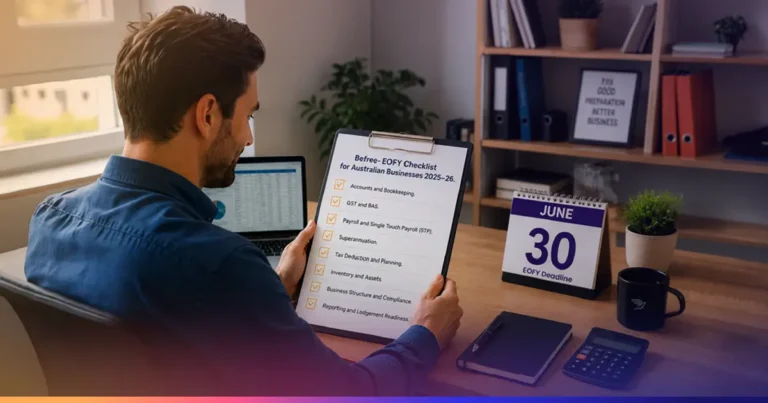
The end of the financial year doesn’t have to be stressful. With the right EOFY checklist in hand, Australian businesses can close out the year confidently, meet every ATO obligation, and set themselves up for a stronger year ahead. Whether you’re a sole trader or a growing business owner, this guide walks you through everything you need to action before 30 June.
What Is an EOFY Checklist and Why Does It Matter?
An EOFY checklist is a structured list of financial, tax, and compliance tasks that Australian businesses should complete before the end of the financial year on 30 June. It matters because missing key deadlines, whether it’s superannuation contributions, BAS lodgements, or payroll reconciliations, can lead to ATO penalties, missed deductions, and unnecessary stress when tax time rolls around.
Getting organised early means fewer surprises, more accurate reporting, and a cleaner handover to your accountant or bookkeeper.
What Does This Mean for Small Business Owners Specifically?
1. Review and Reconcile Your Accounts
Before anything else, make sure your books are clean and up to date.
- Reconcile all bank accounts, credit cards, and payment platforms
- Review accounts receivable and follow up on outstanding invoices
- Write off any bad debts that are genuinely unrecoverable (these may be tax-deductible)
- Reconcile your balance sheet accounts, including loans and assets
2. Lodge All Outstanding BAS and IAS
If you’re registered for GST, all Business Activity Statements (BAS) must reflect accurate figures before year-end. Check that:
- All quarterly or monthly BAS lodgements are up to date
- GST collected and GST credits claimed are correctly recorded
- Any PAYG withholding obligations are reconciled and reported
3. Process Payroll and Superannuation
Super contributions are one of the most common EOFY trip-ups for SME owners. To claim a tax deduction for superannuation in the current financial year:
- Contributions must be received by the super fund before 30 June
- Process your final payroll run for the financial year
- Reconcile STP (Single Touch Payroll) data to ensure it matches your payroll records
- Issue payment summaries or confirm STP finalisation for each employee
4. Maximise Deductions Before 30 June
This is the time to think strategically about legitimate deductions available to your business.
- Consider prepaying deductible expenses such as insurance, rent, or subscriptions
- Review eligible asset purchases under the instant asset write-off provisions — assets must be installed and ready for use by 30 June
- Review any outstanding repairs or maintenance that can be completed and claimed this financial year
5. Take Stock of Inventory and Assets
- Conduct a stocktake if your business holds inventory — the ATO requires this for most businesses carrying trading stock
- Review your fixed asset register and update it with any disposals or additions
- Check depreciation schedules are current
6. Review Your Business Structure and Tax Position
EOFY is a good moment to take a wider look at your position.
- Review your business structure with your accountant — is it still the most tax-effective arrangement?
- Consider whether there are any trust distributions, director fees, or shareholder loan issues to address
- Ensure any Division 7A loans are properly documented
What Happens If I Miss an EOFY Deadline?
How Can a Bookkeeping or Accounting Partner Help at EOFY?
EOFY is one of the busiest periods for any business finance function. Many SME owners find that extending their team with dedicated accounting support, rather than scrambling at year-end, makes the difference between a smooth close and a costly scramble. A capable accounting partner can handle reconciliations, payroll finalisation, BAS lodgements, and ATO correspondence on your behalf, so you can focus on running your business.
Befree works with Australian businesses to provide experienced, detail-oriented accounting and bookkeeping support that scales with your needs, particularly at high-pressure times like EOFY.
Ready to Close the Year With Confidence?
Use our comprehensive EOFY checklist to work through every obligation before 30 June — and if you’d like experienced support behind your books, contact us.