




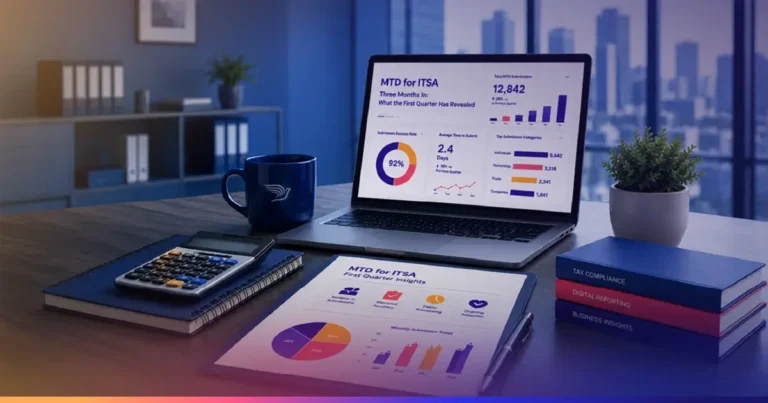
MTD for ITSA became a live reporting requirement on 6 April 2026, and the first quarter of digital record-keeping under the new regime closed on 5 July. With the first quarterly update deadline now falling on 7 August 2026, firms across the UK have had a genuine test run of Making Tax Digital for Income Tax Self Assessment in practice, not just in theory. Here is what that first quarter has actually revealed, and what it means for accountants supporting clients through the rest of the year.
What Is MTD for ITSA?
Making Tax Digital for Income Tax Self Assessment (MTD ITSA) replaces the single annual Self Assessment return, for those within scope, with a system of digital record-keeping and quarterly updates submitted directly to HMRC through compatible MTD software. Instead of one large exercise at year-end, affected sole traders and landlords now report income and expense totals four times a year, followed by a Final Declaration once the tax year closes.
The MTD ITSA meaning, in short, is a shift from annual reporting to ongoing digital reporting. It does not change how much tax is owed. It changes when and how information reaches HMRC.
Who Is In Scope, and What Are the MTD for ITSA Thresholds?
The current MTD for ITSA thresholds apply to sole traders and landlords with gross income (turnover before expenses) above £50,000, based on their 2024/25 Self Assessment return. This applies per person, combining self-employment and property income together, not per source. From April 2027, the threshold drops to £30,000, bringing a significantly larger population of clients into scope.
For accounting firms, this means the current cohort is really a preview. The lessons from this first quarter apply directly to the much larger group joining next year.
What Has the First Quarter Actually Shown Practices?
Record-keeping habits vary far more than MTD software choice
MTD Bridging software is doing more heavy lifting than expected
A meaningful number of clients are still working from spreadsheets rather than moving to cloud accounting platforms. That is permitted under MTD for ITSA HMRC rules, provided the spreadsheet links digitally to HMRC via MTD bridging software and avoids manual copy and paste. This has meant firms spending extra time making sure clients’ digital links to HMRC are truly automatic, not just manual copying dressed up to look compliant.
Also Read: How Accounting Firms are Managing MTD ITSA Compliance
Clients are confusing quarterly updates with a mini tax return
The penalty question keeps coming up, and the answer offers some breathing room
Terminology confusion persists
How Should Accounting Firms Prepare for the Next Quarterly Deadline?
With the first deadline of 7 August 2026 approaching, and further deadlines on 7 November 2026, 7 February 2027, and 7 May 2027, the practical priorities for firms are straightforward:
- Confirm every in-scope client’s software is genuinely linked to HMRC, not just installed
- Reconcile records for the April to June or April to July period well before the deadline, not on the day
- Reinforce with clients that quarterly updates are totals, not finalised accounts
- Use this quarter’s experience to flag which clients will need closer support as the £30,000 threshold expansion approaches in 2027
Firms that treat this first cycle as a diagnostic exercise, rather than simply a compliance task to clear, will be far better positioned for the volume increase ahead.
If your practice is reviewing its approach to MTD for ITSA client management ahead of the next filing deadline, Befree’s Making Tax Digital service can support your team with the processes needed to keep quarterly reporting accurate and on schedule. Connect with us to learn more or register for MTD.